Rethinking Patient Engagement Beyond the Clinical Visit
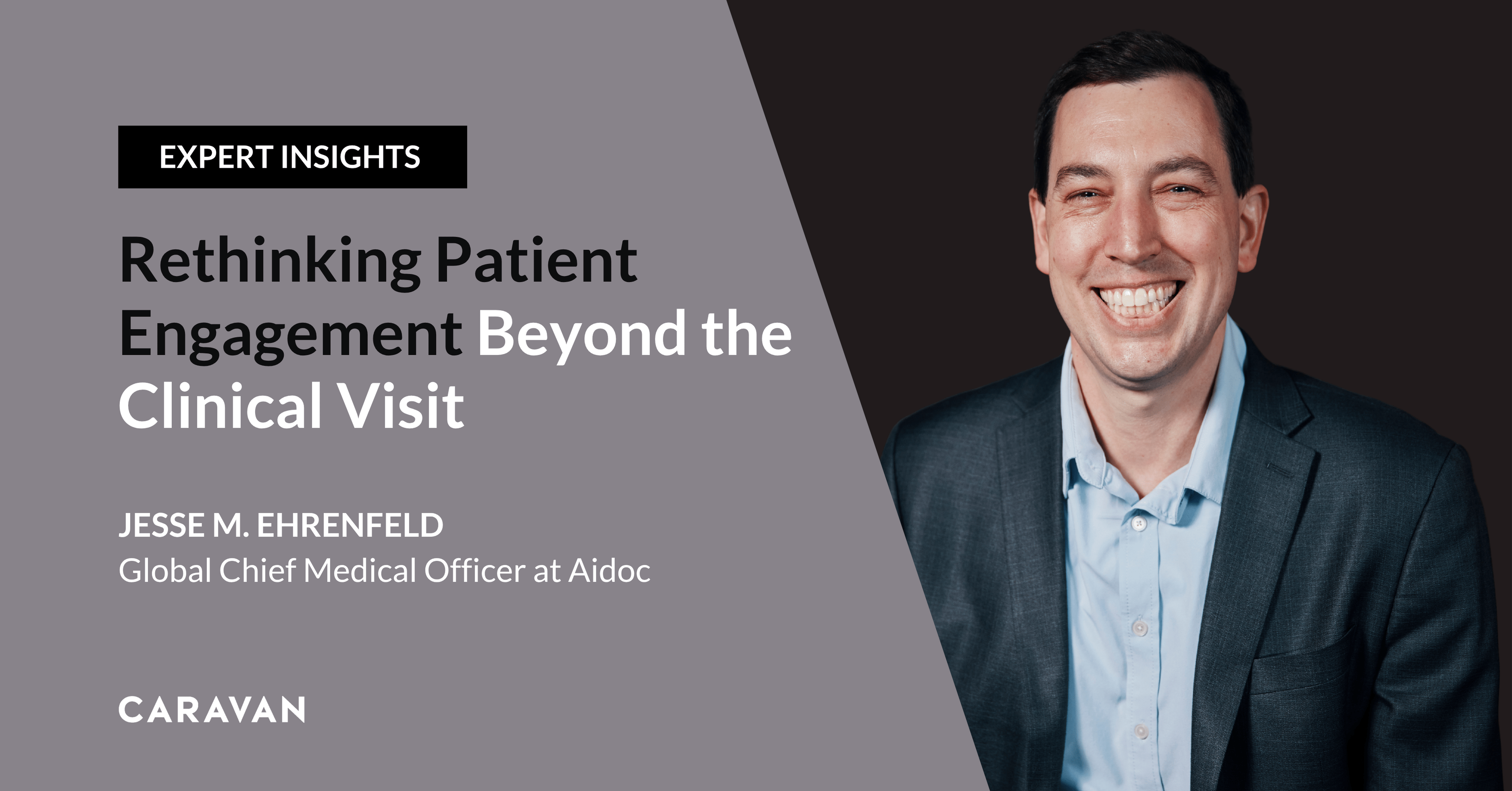
Up to 80% of medical information patients are told during office visits is forgotten immediately, and much of what is remembered is frequently misunderstood. In this interview, Jesse Ehrenfeld, shares his perspective on what it takes to turn health information into meaningful action. Drawing on his experience across clinical medicine, informatics, research, and digital health, he explores patient engagement, health equity, behavior change, and how technology can support more understandable, relevant, and actionable health experiences.
1. You’ve worked across clinical medicine, informatics, research, and now digital health. Where do you see the biggest disconnect between what healthcare professionals know patients need to understand and what actually helps people engage with their health outside of the clinical encounter?
The biggest disconnect is that healthcare often confuses providing information with creating understanding and understanding with engagement. Clinicians tend to focus on what patients need to know. Patients are often trying to answer a more immediate question: What does this mean for me, and what should I do next? People do not experience health as a series of one off clinical encounters. They experience it while dealing with work, family responsibilities, financial pressures, cultural expectations, fear, and competing priorities. Even medically accurate and comprehensive information can fail if it arrives at the wrong time, uses unfamiliar language or asks too much of someone who is already overwhelmed. Outside the clinical encounter, engagement improves when information is trusted, personally relevant, appropriately timed, and connected to an achievable next step. We should design information so people can understand it, feel confident, and know what to do next. That includes preserving a clear path back to a healthcare professional when they have questions.
2. With your experience in clinical informatics and digital health, what do you believe actually drives sustained engagement? And where do technology, content, behavior change, and the human connection each fit into that equation?
Sustained engagement is less about getting people’s attention and more about helping them understand their health and feel confident taking action. People are more likely to remain engaged when an action feels personally meaningful, fits into their daily lives, produces visible progress, and is reinforced by a source they trust and they understand it. Technology should make the right action easier. It can personalize timing, remove administrative friction, provide reminders and feedback and connect people with appropriate care. Content provides a credible why and a clear what, but it must be concise, relevant and understandable. Behavior change principles help translate good intentions into realistic routines by breaking complex goals into manageable steps and reinforcing progress along the way. Human connection contributes something the other elements cannot fully replicate: empathy, trust, accountability and judgment especially when circumstances change or the evidence is uncertain. The strongest experiences combine all four elements. Technology can extend the reach and continuity of a trusted relationship but it should augment that relationship rather than impersonate or replace it. A useful test is whether the experience leaves someone feeling more capable and supported.
3. There is no shortage of health information online. The harder problem seems to be creating information that is medically trustworthy, understandable, relevant to the individual, and actionable. What standards should organizations use when deciding whether health content is actually worthy of putting in front of patients or members?
I would apply 5 standards: 1) clinical validity 2) clarity 3) relevance 4) actionability 5) accountability. Content should be evidence based, current and transparent about its authorship, sources, conflicts of interest and areas of uncertainty. It should be tested with the people it is intended to serve, not simply reviewed by experts to ensure that people with different levels of health literacy, numeracy, language proficiency, disability and cultural background can understand it. Relevant information should be personalized to the individual without making unsupported claims. It should clearly explain what to do next, what warning signs to look for, and when to seek help. Success should be measured by understanding, safety, behavior, and outcomes, not just clicks or views. Ultimately, the standard should not simply be, Would a clinician approve this? It should be, Can the intended person accurately explain what this means, make an informed choice, and take the next appropriate step?
4. In your 2025 World Medical Association article, “Techquity: Achieving Health Equity through Innovation,” you share that health equity needs to be built into technology from the start. What would “equity by design” look like when we apply that principle to the health information and experiences patients receive?
Equity by design begins with who is at the table, whose experiences and data are represented, who may be excluded, and who could bear the consequences of a poorly designed experience. It means involving the communities an organization intends to serve as genuine and ideally compensated co-designers rather than asking for feedback after major decisions have already been made. For health information, organizations must account for language, literacy, disability access, cultural context, broadband and device limitations, caregiver roles, cost, privacy concerns, and historical reasons for mistrust. They must also preserve non-digital pathways and access to human assistance. Organizations should test experiences across diverse populations, examine engagement and outcomes by demographic and socioeconomic group and continue monitoring for differential errors, harms, or drop-off after launch. Average performance can conceal significant gaps. As I argued in my previous writings, equity must be incorporated during the earliest stages of design so that bias is not embedded in the technology or experience. Translation alone is not equity by design. Equity should be treated as a product requirement, a governance responsibility, and a measurable outcome, not simply an aspiration.
5. When we talk about health equity, the conversation often focuses on access to care, affordability, and technology. How important is access to understandable, culturally relevant, and actionable health information in closing gaps in outcomes, and what are organizations still overlooking?
Access to understandable and actionable information is itself a form of access to healthcare. A person can technically have an appointment, a prescription, insurance coverage or a digital tool and still be unable to benefit if they do not understand the diagnosis, the available choices, the associated risks or what they are supposed to do next. We should treat health literacy as a responsibility of healthcare systems, not as a deficiency in individual patients. Culturally relevant communication also involves much more than translation. It requires attention to values, trusted messengers, family and community decision-making, previous experiences with healthcare and the practical realities that determine whether a recommended action is feasible. Organizations frequently overlook the conditions under which health information is received: fear, pain, cognitive overload, time pressure, stigma, financial constraints, caregiving responsibilities, unstable housing, limited digital access and mistrust. Too often, success is defined as information delivered. The more meaningful standard is whether the information was understood, trusted, acted upon, and associated with comparable outcomes across populations.
Successful patient support is not defined by how much information a health system provides, but by how effectively that information serves patients. When education is tailored, diverse, and easy to understand, the care journey becomes easier and more beneficial to both patients and the healthcare team.
About Jesse M. Ehrenfeld
Jesse M. Ehrenfeld, MD, MPH, is a physician, clinical informaticist, researcher, and healthcare executive whose work spans patient safety, health equity, public policy, and responsible innovation. He served as the 178th president of the American Medical Association and is Global Chief Medical Officer at Aidoc. A practicing anesthesiologist and U.S. Navy combat veteran, he holds academic appointments at the Medical College of Wisconsin, Vanderbilt University, and the Uniformed Services University of the Health Sciences. Board-certified in anesthesiology and clinical informatics, he has authored more than 275 peer-reviewed publications and has held advisory roles with the World Health Organization, the U.S. Surgeon General, and the National Academy of Medicine.
About CARAVAN
CARAVAN Wellness is the #1 global leader in expert content solutions for health, wellness, workplace, financial care, and education. CARAVAN impacts millions of people by helping healthcare organizations, health plans, employers, and digital platforms educate, engage, and empower people with trusted expert content. At CARAVAN, we envision a world where everyone can access trusted education and resources, regardless of their age, income, or location. Learn more at caravanwellness.com